
First and foremost, every reading experience becomes a prewriting experience. Making students aware of the characteristics of genre is the first step. This instruction begins as early as kindergarten and should be reinforced each subsequent year. Then, as students begin writing narrative stories for the purpose of entertaining others, there are a number of skills necessary to craft successful pieces.
The skills of narrative writing are crucial for authors to craft compelling and well-rounded narratives, applying not only to seasoned writers but also to young authors just starting out. Here’s a breakdown of each skill and how it plays a pivotal role in storytelling, particularly in helping writers grow and refine their craft.
- Organization
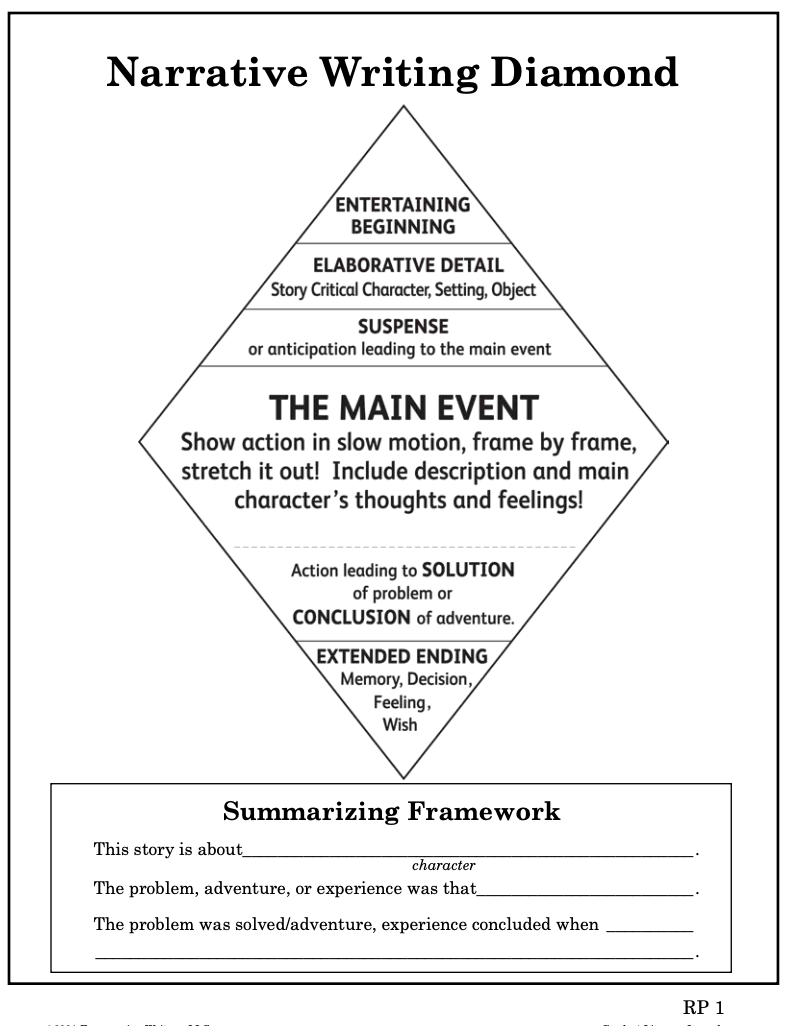
Why it's important: Organization is the backbone of any narrative. Young authors need to understand the shape and structure that a story typically takes, from the beginning through to the middle and the end to ensure stories that are organized and coherent. As part of organization, students need to outline the basic pattern of narrative stories using the narrative summarizing framework.
How to teach it: A simple approach to teaching organization is introducing students to the narrative writing diamond. The diamond represents the shape a narrative story takes and includes the specific skills authors use to fully elaborate their stories. It helps students visualize how the events in their stories should unfold, ensuring that the narrative has balance and progression, as well as story engagement. Along with the diamond, the narrative summarizing framework serves as a story map to use as a prewriting tool or graph.
- Crafting Entertaining Beginnings
Why it's important: The beginning of a story is crucial because it sets the stage and hooks the reader. It should immediately draw the reader into the world of the story, introducing the character, setting, and tone. An effective opening will raise questions that compel the reader to continue and it should begin as close to the Main Event as possible.
How to teach it: Authors often use specific techniques to craft an engaging beginning, such as Action, Dialogue, Thought/Question, and/or Sound.
- Elaborative Detail
Why it's important: Elaborative detail is what transforms a good story into a memorable one - bringing the story to life. Elaboration is not just assigning adjectives to details, it’s about giving the reader a vivid sense of the world the characters inhabit by engaging all their senses—sight, sound, touch, taste, and smell. This allows readers to experience the events and characters as if they were there.
How to teach it: Encourage young authors to use descriptive language to describe emotions and surroundings – characters, settings and objects. This is accomplished through detail-generating questions that allow students to progress beyond color words, size words, number words, to vivid description of critical elements using the five senses.
- Suspense
Why it's important: Suspense keeps readers on the edge of their seats and leaves them wanting more. It involves raising worry, concern, doubt and a sense of anticipation. Without suspense, a story may feel flat or uneventful, even if the plot is interesting.
How to teach it: Authors use several techniques to build suspense and keep the anticipation dangling: story questions, word referents, and the magic of three.
- Fully Elaborated Main Events
Why it's important: The main event is the heart of the story. It builds through slow-motion action, frame by frame, developing a single, significant event in a way that feels satisfying and impactful.
How to teach it: Help students realize that the main event should never feel rushed or skimmed over. They should explore it deeply from the perspective of the main character—what do they see, feel, and think as it unfolds? By expanding on the event using Action, Description, Dialogue, Thoughts, and Feelings, the author ensures that this pivotal event resonates with the reader.
- Extended Story Endings
Why it's important: A satisfying ending gives the reader closure and makes the journey worthwhile. It allows the main character to reflect on what has happened and what they’ve learned, which brings the narrative to a fulfilling conclusion. Without this reflection, a story might feel abrupt or incomplete.
How to teach it: Students should understand that after the conflict is resolved, there’s still room for reflection. What does the character think about the events? How do they feel about the resolution? What have they learned, and how have they changed? Students will summarize the main character’s thoughts, feelings, memories, hopes/wishes, or decisions in regard to the main event.
Bringing It All Together
Each of these skills contributes to the depth and engagement of a narrative. By teaching writers how to develop their organization, build strong beginnings, enrich their writing with detail, create tension, expand on the main events, and close with reflection, you give them the tools to write compelling, multi-layered stories that will captivate readers.
For students, the process of mastering these skills might take time and practice, so encouraging them to use these techniques as part of their writing toolkit will help them become more confident and skilled authors. The skills are intended to be taught one skill at a time and in isolation. Without a doubt, these skills can and should be taught in developmentally appropriate ways. The more they practice, the more they’ll come to understand how these elements interact to make a story truly great.
For more information about what narrative writing is, go to What is Narrative Writing?
Check us out!
Our resources like the Empowering Writers’ Narrative Guide, or the All-in-One Guide take you on a deeper dive into the skills of narrative writing. These guides offer structured tools, strategies, and examples that make it easier to teach and learn the nuances of clear, effective writing. They help break down the steps of narrative stories into manageable pieces, such as how to write a entertaining beginning, craft a well-developed Main Event, and conclude the story with an extended ending.
And the dynamic workshops are an awesome way to reinforce these skills, allowing for hands-on learning and real-time feedback. Have you had the chance to explore any of these resources or workshops yet? They are a great fit for anyone looking to improve their writing expertise!
--------------------
Plus, CLICK HERE to review a Grade 2 sample pack of narrative lessons.