

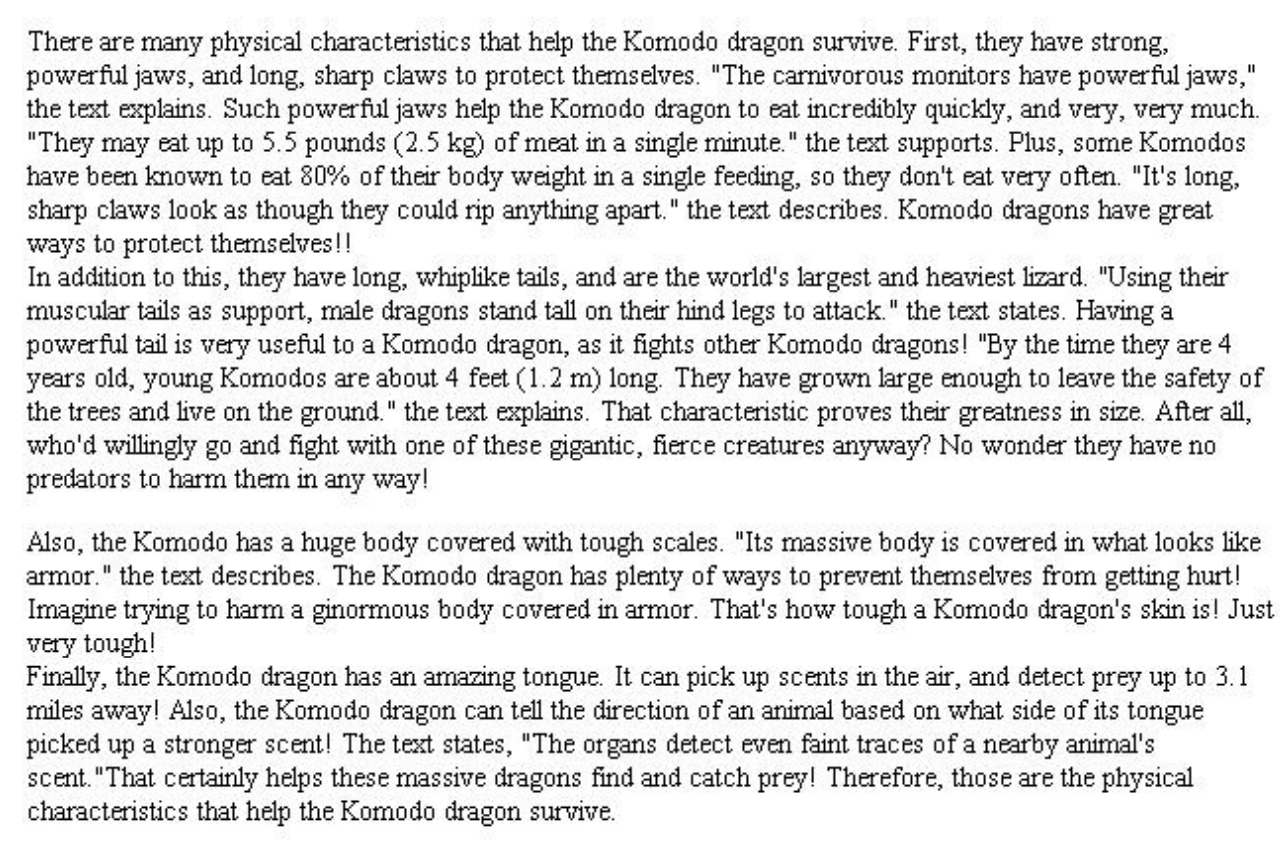
Topic: Characteristics that help the Komodo dragon survive
Main Idea #1: jaws and claws
Main Idea #2: tails and weight
Main Idea #3: tough scales
Main Idea #4: tongue
What Works:
- Organization: The student wrote a full essay that includes an introduction statement, several main idea paragraphs and a conclusion statement. Additionally, there are transitions that move the reader from one idea to the next.
- Textual Evidence/Elaboration: Each paragraph includes evidence that is clearly cited and/or paraphrased directly from the text. The author also explains the evidence. This is a skillful use of the detail generating questions, What does it look like? And Why is it important?
- “The carnivorous monitors have powerful jaws,” the text explains. Such powerful jaws help the Komodo dragon to eat incredibly quickly and very, very much. “They may eat up to 5.5 pounds (2.5kg) of meat in a single minute,” the text supports.
- They have long whiplike tails. Having a powerful tail is useful to the Komodo dragon as it fights other Komodo dragons!
- “Its massive body is covered in what looks like armor,” the text describes. Imagine trying to harm a ginormous body covered in armor.
Feedback with Prescriptive Lesson - Focus Skill
Main Ideas/Reasons: The student would benefit from lessons on developing main ideas sentences that are creative and adding additional high level vocabulary.
- Informational Skills: Section 1 Lesson 10 Alternatives to Boring, Redundant Main Idea Sentences
- Informational Skills: Section 1 Lesson 11: Revising Boring, Redundant Main Idea Sentences
- Informational Skills: Section 1 Lesson 15 Word Referents
Introductions and Conclusions: There is only one sentence for the introduction and one for the conclusion. This response would be enhanced with full introduction and conclusion paragraphs.
- Informational Skills: Section 4 Lesson 6 Writing a Response to Text Introduction
- Informational Skills: Section 4 Lesson 13 Writing a Response to Text Conclusio
Author’s Group Revision Model
To teach revision, use a whole class model. Project the sample for revision and discuss the strengths and weaknesses of the piece. Choose one skill that will address the weakness and with student participation, go through the revision process. This allows students to see revision in action and provides a structure for their own revision process. Using the suggested feedback from above, here is an example of a revised version of this piece.
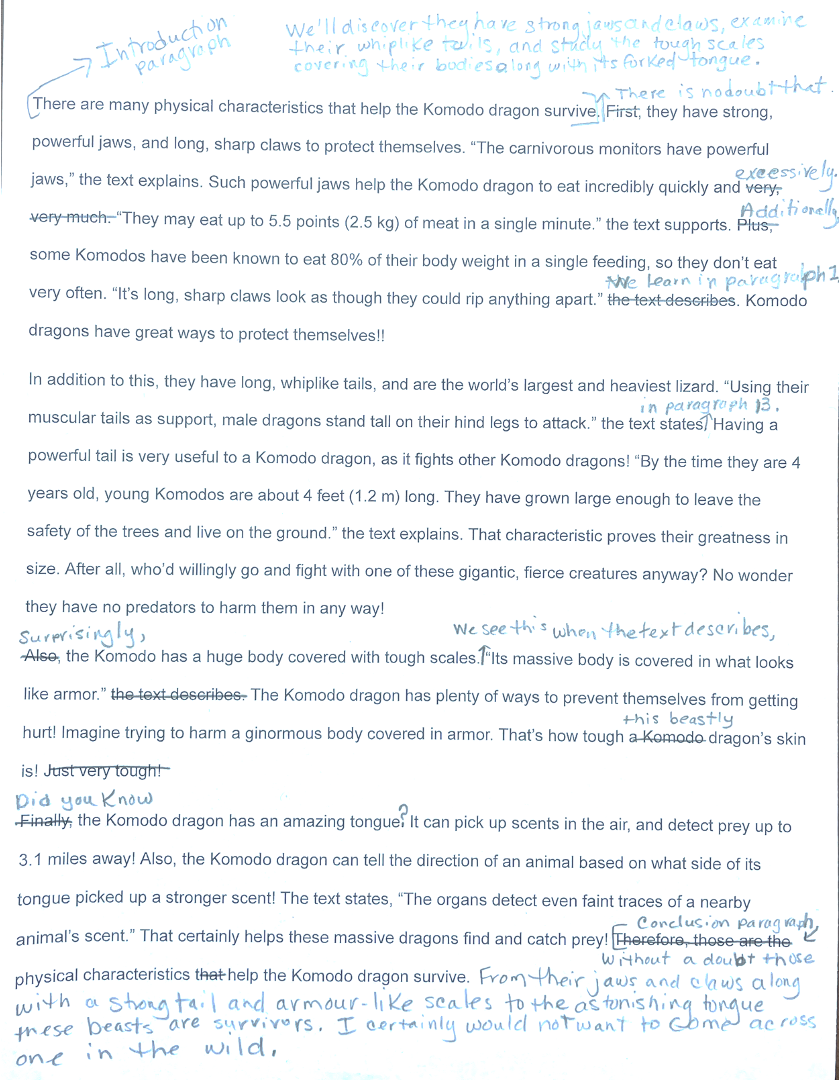
A full introduction and conclusion paragraph creates a cohesive essay. The main idea sentence starters adds variety and powerful vocabulary to the piece.
What Next?
For more information on Constructed Response, consider joining our training team for a comprehensive professional course that will outline the steps for teaching constructed response, both short and extended. Click this link to register.